by Fern Shaw | Sep 11, 2015 | Water Coolers
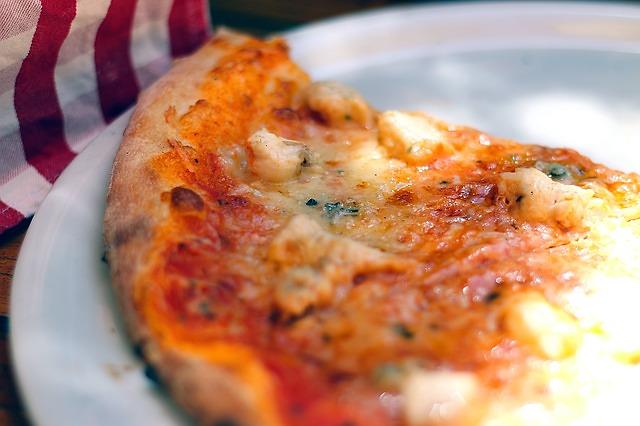
I recently read a delightful article about a woman who ordered a pizza in Italy and was told that such a pizza doesn’t exist.
The gist of the *article is about how the journalist, who resides in Italy, went to her local takeaway pizzeria and ordered a marinara to which the takeaway owner and pizza maker promptly told her that such a pizza doesn’t exist.
According to the pizza maker, the customer had ordered a pizza rossa.
The differences?
Traditionally, a marinara is a tomato and garlic pizza.
A pizza rossa is a simple tomato and garlic pizza – with the addition of mozzarella.
The journalist was used to a marinara being a pizza with tomato, garlic and mozzarella. The pizza maker vehemently disagreed. She said she was perhaps thinking of a margherita and that she could perhaps make her a margherita with garlic.
A margherita is a pizza topped with tomato and mozzarella.
I found the whole incident to be very amusing as I imagined the face-off between someone who is clearly a pizza purist and someone who just enjoys good pizza.
What’s your opinion on the matter? Are you a purist or not? I’m hedging my bets because pizza has obviously evolved radically from its origins in Italy and it has been significantly changed to suit the ever changing tastes depending on which country you live in.
What I do know is that I’m a thin crust baby all the way. And if you put pineapple or seafood on my pizza, things will get ugly pretty quickly.
I’m heading up to the water cooler station to get everyone’s opinion – as with all things food, it should make for an interesting debate! Ciao bella!
*excerpts from an article at the BBC Magazine
by Fern Shaw | Jul 22, 2015 | aquaid tyne wear, Charity, Christian Aid, Water Coolers
The Swimming Scuba Diver
One of the aspects of working in the marketing and social media sphere that I really enjoy is getting to ‘know’ some of the many people that work at AquAid. To date, I’ve ‘met’ a serious traveller – Josh; a carer of animals and Tough Man competitor – Scott; a stand-up comedian – Martin; a Super Dad – Ross; and a Ninja – Dennis.
Last week, I spoke to Emir Dobson, franchisee at AquAid Middlesborough and asked her if she would be kind enough to put pen to paper and despite being rather busy, she graciously took the time out to answer my questions.
I was so tickled with her replies as I again realised that the individuals that work at AquAid really are quite a mixed bag and full of surprises – who knew that AquAid Middlesborough boast their very own scuba diver? So, without further ado, here’s what Emir had to share, pretty much verbatim:
Name: Emir Dobson
Role at AquAid: Manager – AquAid Tyne & Wear
Years at AquAid: Too long.
What do you enjoy about your job? The people we meet!
Tell us something interesting about yourself: Achievements: Working alongside my husband in all these years without a major incident!!!
How did you get involved with AquAid? I became involved in AquAid due to my connection with Christian Aid – I am passionate about the work that they do – my contribution is through donations.
Hobbies: Keeping with the water theme – I enjoy swimming and scuba diving.
What is it about swimming and scuba diving that you enjoy so much? I enjoy water… swimming and scuba diving keep you fit, they’re good for you…
When do you do the above? Enjoy diving as often as I can.
Why do you do it? It’s good fun and the people are great criag.
I enjoy diving anywhere there is water. In the North Sea, the wrecks are good and the sea fish.
In warmer climates – every dive is different; you see different fish, coral, wrecks – its good fun.
How long have you been involved with this? About 10 years.
Claim to fame – Just being alive!
What are you hoping to achieve or to do in the future? As soon as the family have moved out of the family home – my husband and I are going to travel – Thailand; Africa; USA.
Notes: No matter what happens – we are all the same – we eat, sleep, and breathe … the same. x
Thank you Emir, so interesting how water plays such a huge part in your life, from both a business and personal perspective. I wish you many good dives and lots of criag!
by Fern Shaw | Jun 8, 2015 | Water, water cooler, Water Coolers
Last week I blogged about memes (see image above); the word itself always makes me a little uncomfortable – memes … Manitou’s …mammaries – but then that’s how my brain processes word association – it may not be how yours does. (Aren’t you lucky?!)
With memes in mind, I got to thinking about what it is that makes people associate water coolers (or more correctly – areas where water coolers are) with humour?
It’s pretty simple if you think about it – when people head off to replenish their daily H20 quota (and another Blogista aside – isn’t it nice to know that nowadays you have a plethora of water cooler machines to choose from – even ones to fit on your desktop – aha – like your desktop does) – it’s usually their downtime; take a break time; time to walk off work related stress; so ostensibly when they reach the water cooler and they see a colleague (or two or five), they remember that they haven’t shot the breeze; told the latest joke; compared footie scores; swapped a bit of skinny – so they break into full splab.
Of course this sharing can often have pretty dodgy and potentially disastrous results – perhaps *Tim in HR doesn’t appreciate Maggie from Sales telling off-colour jokes and Pandora from Filing is ready to throttle Syd from Social Media because he keeps on winding her up about his team’s great results versus hers.
I think that pretty much explains the humour at the water cooler connection. If you don’t believe me, then take a stroll down to your water cooler – I guarantee you’ll see my hypothesis in action. If there’s no humorous activity, create your own. Remember though – directing the water from the water spout to squirt at colleagues probably won’t be perceived as funny.
*names and characters in this blog are all fictional.
by Fern Shaw | May 28, 2015 | Water, Water Coolers
I was wandering through the dreaded social media the other day and I saw an absolutely beautiful black and white (ha) photo of zebras drinking at a water hole that an acquaintance had taken whilst on tour in Namibia.
Those who are into photography will know that shooting black and white photos can be the hardest photos to take. What spectacular contrasts we may see with the naked eye as being stark and edgy invariably result in dull as dishwater images when shot in black and white. Anyhow, it was while I was looking at this photo (not the one above, by the by) thinking about how amazing zebra photos look especially in black and white that I started thinking about why it is that zebras are stripy and most other African wildlife aren’t?
It’s apparently not to do with camouflage, as I believed it was, but for something else.
There are one or two new theories:
Cooling effect
One is the ‘cooling eddy’ theory. When air hits a zebra, the currents are stronger and faster over the black parts (since black absorbs more heat than white) and slower over the white. At the juncture of these two opposing airflows, little eddies of air may swirl and serve to cool a zebra’s skin.
No landing zone for disease carrying critters
The other idea holds that more stripes may be a barrier against disease, since disease-carrying biting flies, like horseflies, tend to like it hot. Experiments in the field have shown that biting flies don’t like landing on striped surfaces.
Whatever the reason, it’s such a nice thought that nature, once again, shows us humanoids how beating the heat is done. Sadly, despite my request, it seems unlikely that we’ll be introducing zebra striped water coolers any soon. Management snorted when I asked and then (rather snidely I thought) suggested that if I were so into zebra stripes I could always wear my own stripes to the office, as long as I didn’t pitch up wearing my summer zebra striped onesie.
by Fern Shaw | May 19, 2015 | Charity, water cooler, Water Coolers
‘A wishing well is a term from European folklore to describe wells where it was thought that any spoken wish would be granted. The idea that a wish would be granted came from the idea that water housed deities or had been placed there as a gift from the gods, since water was a source of life and often a scarce commodity.’ ~ Wiki
Here at AquAid, we’ve adapted the concept of the wishing well slightly by ensuring that through the provision of water coolers to our valued customers that this translates into building actual water wells for those less fortunate in Africa.
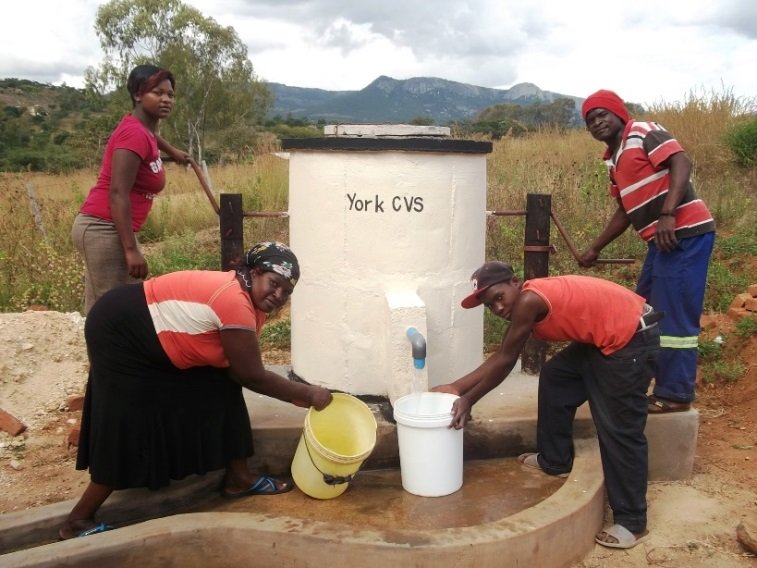
How it works is that AquAid, who long have a history of supporting sustainable charities, formed a charity called The Africa Trust. This organisation is responsible for building said water wells or, as they are affectionately known, Elephant Pumps. Using donations from a portion of the revenue raised from the sales of water coolers, The Africa Trust have built more than 5 0000 Elephant Pumps throughout Africa, which provide more than 2 million people with safe drinking water. The pump is built (see photograph online in the article) using a modified design based on an ancient Chinese rope pulley system that uses materials that are easy to repair and maintain locally. An Elephant Pump can last for more than 15 years and its design is such that 95% of built pumps continue to operate throughout the continent.
We recently invited York CVS, a Leeds based AquAid customer, to participate in a well building campaign and were delighted when they graciously accepted.
York CVS themselves are all about help and support. Since 1939, York CVS has supported thousands of local charities, voluntary organisations and social enterprises to focus on what they do best – making a difference.
They provide a range of support, training and advice to help organisations set up, flourish and even finish if they feel their work is done.
Ruth Stockdale, Communications and Marketing Adviser at York CVS expressed enthusiasm about the well building campaign, “York CVS is proud to be working with AquAid and is delighted that by providing clean, fresh water here in York, we are able to support others to receive the same benefits in Africa.”
York CVS’ decision to participate in this water pump building campaign means that a rural community in Africa will now have access to safe, clean drinking water.
If you currently have an AquAid water cooler and would like to find out how you can go about sponsoring your very own water well, at no extra cost, please contact us.
Via our website: https://www.aquaidwatercoolers.co.uk/contact
Via e-mail: marie@aquaidwatercoolers.co.uk
Via telephone: 0800 772 3003
If you would like to enquire about purchasing a water cooler, drop us a line or give us a shout at any of the above. We’d love to be able to assist. And you can, of course, be very well (ha) on your way to sponsoring your very own water well.